3.1 Linear Models: Class Notes
3.1a
Various situations are modeled by differential equations.
- Growth and decay:
If , then is an initial population or amount.
Used for populations, radioactive decay, and drug concentrations.
: a constant relative growth/decay rate. is the relative growth/decay rate as a decimal ( for growth, for decay).
- Newton’s law of heating and cooling:
is the temperature and is time. is the surrounding temperature (the temperature of the medium), so is the temperature difference, and .
- Mixtures:
- -series electrical circuit:
: inductance (henries, h); : resistance (ohms, ); : impressed voltage (volts, V); : current (amperes, A).
- -series electrical circuit:
: capacitance (farads, f); : charge (coulombs, C); .
Example
A population of bacteria in a culture grows at a rate proportional to the number of bacteria present at time . After 3 hours it is observed that 400 bacteria are present. After 10 hours 2000 bacteria are present. What was the initial number of bacteria?
Solution
The growth rate is proportional to the population:
The population at time is the initial population, (so ). The solution to the model is
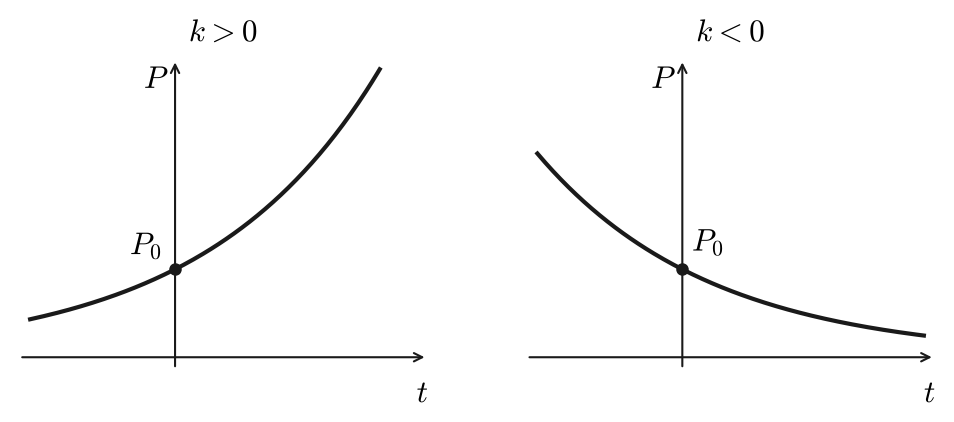
Two graphs of , each crossing the -axis at . Left, : the curve increases (growth). Right, : the curve decreases toward 0 (decay).
Use the two observations, and :
Divide the first equation by the second ( cancels):
The growth rate is about 23%. Then
Answer:
Side note: half-life
For decay, the half-life (lambda) is the time for the amount to fall to half: . Then
3.1b
Example
A thermometer is taken from an inside room to the outside, where the air temperature is F. After 1 minute the thermometer reads F, and after 5 minutes it reads F. What is the initial temperature of the inside room?
Solution
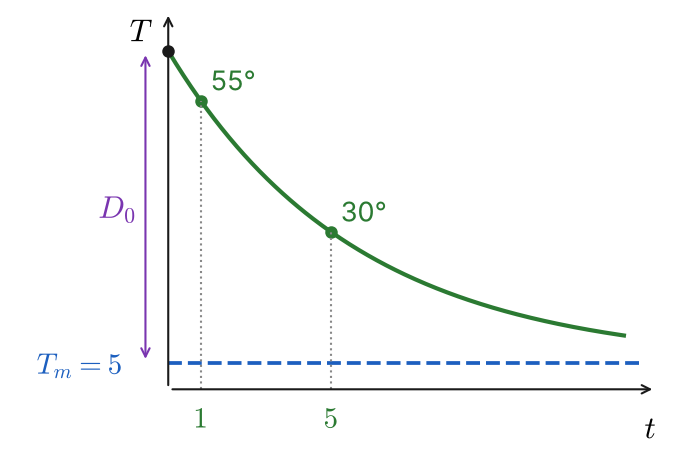
Sketch of the temperature : it starts at the unknown room temperature, passes through at and at , and decreases toward the horizontal asymptote . The initial gap between and is .
is the initial temperature difference: .
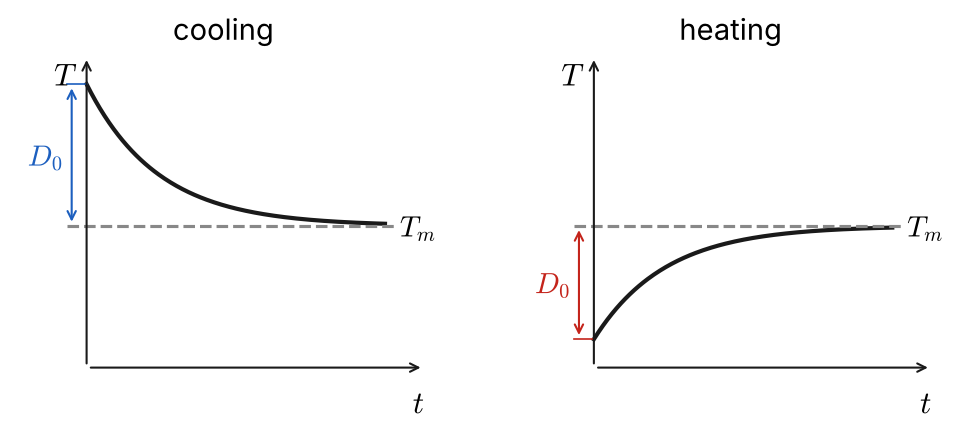
Left, cooling: starts degrees above and decreases toward (here ). Right, heating: starts below and increases toward it (here ). In both, .
Here , so
Use and :
Dividing gives
Then, from :
Since and , the initial thermometer temperature is .
Answer:
3.1c
Example
A large tank is filled to capacity with 500 gallons of pure water. Brine containing 2 pounds of salt per gallon is pumped into the tank at a rate of 5 gal/min. The well-mixed solution is pumped out at the same rate. Find the number of pounds of salt in the tank at time .
Solution
The tank starts with pure water, so .
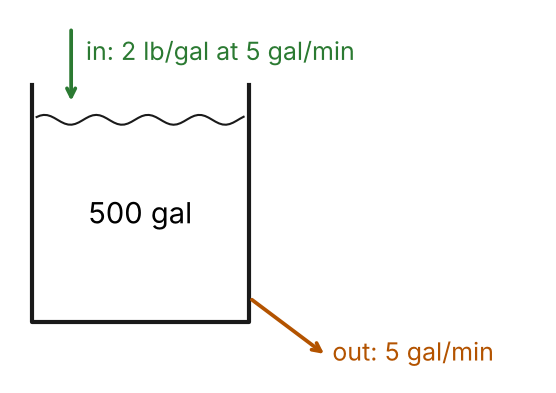
A tank initially holding 500 gallons of pure water. Brine with 2 lb of salt per gallon flows in at 5 gal/min; the well-mixed solution flows out at 5 gal/min, so the volume stays 500 gallons.
Rate salt in:
Rate salt out:
This is linear:
gives .
Answer:
In the long run, lb.
Example
Solve the previous problem under the assumption that the solution is pumped out at a faster rate of 10 gal/min. When is the tank empty?
Solution
Still with a 500-gallon tank and salt coming in at 10 lb/min. The tank gains 5 gal/min and loses 10 gal/min, so it is losing 5 gal/min: the volume at time is gallons, and the tank is empty in 100 min.
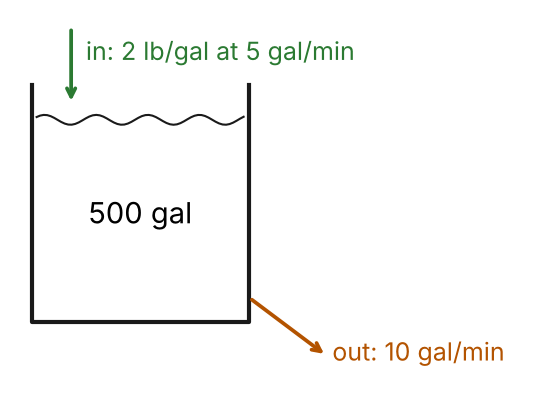
A tank initially holding 500 gallons of pure water. Brine with 2 lb of salt per gallon flows in at 5 gal/min; the well-mixed solution flows out at 10 gal/min, so the volume at time is gallons.
Rate salt out:
: , so .
Answer:
The tank is empty at min.
Example
A 200-volt electromotive force is applied to an -series circuit in which the resistance is 1000 ohms and the capacitance is farad. Find the charge on the capacitor if . Determine the charge and current at s. Determine the charge as .
Solution
Here , , and , so .
Divide by 1000:
The initial condition is on the current, :
Answer:
At s (so ):
As , coulomb.