2.4 Exact Equations: Class Notes
2.4a
A partial derivative is an ordinary derivative holding all but one variable constant.
Computation and notation: for ,
Here treats as a constant, and treats as a constant. Taking one more partial derivative:
The second mixed partial derivatives are equal: .
Recall
For , (rise over run), so . This is the differential of .
Now, for ,
This is the full differential of , or the exact differential.
Consider as a level curve of a surface. For example, if , then becomes , a circle of radius . Each such circle is a level curve of the surface :
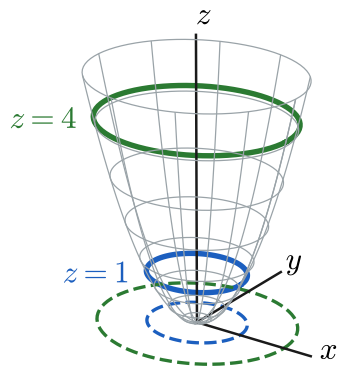
The bowl-shaped surface . Horizontal slices at and are circles; projected down to the -plane (dashed) they are the level curves and .
For the level curve , the (full) exact differential is
For our work, we will consider
the solution to which is . So plays the role of and plays the role of :
In a problem, and are the starting point, and we look for (for instance, ). Since the mixed partials of are equal, if such an exists then
This is the test for exactness: is exact when .
2.4b
Example
Determine whether the given differential equation is exact. If it is exact, solve it.
Solution
If , then is exact. Here
These are equal, so the equation is exact. Integrate with respect to :
Tip: The "constant" of integration is a function , because is constant with respect to .
Now use : differentiate with respect to and set it equal to :
The terms and cancel, leaving
The solution has the form (the constant is absorbed into ):
Answer:
Example
Solution
Put the equation in the form :
These are equal, so the equation is exact. Integrating with respect to would need integration by parts for , so start with instead:
Now use :
For , integrate by parts with , , so , :
The solution has the form :
Answer:
Note: the form of the solution is not or ; it is , an implicit solution.
Aside
Starting with gives the same result:
and gives , so .
2.4c
Example
Solve the given initial-value problem.
Solution
Here and , so the equation is exact. This time, integrate both and :
Integrate by parts with , , so , : . So
Comparing (1) and (2): the term appears in both; the terms with only give , and the term with only gives . Combining them:
Check: and , so is .
Use the initial condition : when , :
Answer:
Example
Solve the given differential equation by finding an appropriate integrating factor.
Solution
These are not equal, so the equation is not exact. The integrating factor is either
Then is exact. Try :
The minus sign moves into the logarithm as the exponent . Multiply the equation by :
This is exact (now ). Integrate with the substitution :
Now :
Answer:
2.4d
Where does the integrating factor come from?
We want to be exact, so we need
If depends on both variables, this is a partial differential equation (PDE), which is not for this class.
Suppose . Then , and we have
If , then , and