2.2 Separable Equations: Class Notes
2.2a
Definition
A differential equation (DE) is an equation containing the derivatives of one or more unknown functions (dependent variables) with respect to one or more independent variables.
Examples: , , and are ordinary differential equations (ODEs); is an example of a partial differential equation (PDE). In this course, we will only work with ODEs.
In the first example, is the independent variable and is the dependent variable.
Definition
The order of a DE is the order of the highest derivative in the equation.
Definition
A first-order separable DE has the form .
To solve, we separate variables and integrate. Dividing by gives
where . Then integrate both sides:
Example
Solve the given differential equation by separation of variables.
Note: This is a nonlinear DE because the equation contains a nonlinear function of (the dependent variable).
Solution
Move the term to the right side, separate the variables, and integrate:
Tip: We only need one constant of integration: constants from both sides combine into one.
Multiply both sides by and rename the constant :
Answer:
This is a one-parameter family of solutions: each value of gives one solution.
Tip: Dividing by assumed . But is also a solution (then and both terms are zero), and it is not in the family for any value of . This is a singular solution.
Definition
Any function , defined on an interval and possessing at least derivatives that are continuous on , which when substituted into an th-order ODE reduces the equation to an identity, is said to be a solution of the equation on the interval.
2.2b
Example
Solution
Separate the variables (the form is ) and integrate:
For the right side, substitute , so :
Answer:
Example
Note: This is a linear DE because all instances of (the dependent variable) are linear.
Solution
Solve for and factor out to see that the equation is separable:
Integrate. For , use integration by parts with , , , :
Exponentiate both sides (raise to each side):
Tip: This uses : the constant in the exponent becomes the factor .
Drop the absolute value by letting :
Answer:
2.2c
Definition
Information such as is called an initial condition. A DE, together with an initial condition is called an initial-value problem (IVP).
Example
Find an explicit solution of the given initial-value problem. Determine the exact interval of definition by analytical methods. Use a graphing utility to plot the graph of the function.
Solution
An explicit solution means we isolate . Separate and integrate:
Tip: Integrating term by term gives instead. Adding to both sides completes the square: , which is the same equation once the constants are combined.
Use the initial condition: when , :
Choose the sign that matches the initial condition: , so we need the minus sign ().
Answer:
Interval: the derivative must be defined. Since and , we need the expression under the root to be strictly positive, not just nonnegative:
Since is always positive, this holds exactly when , that is, .
Answer:
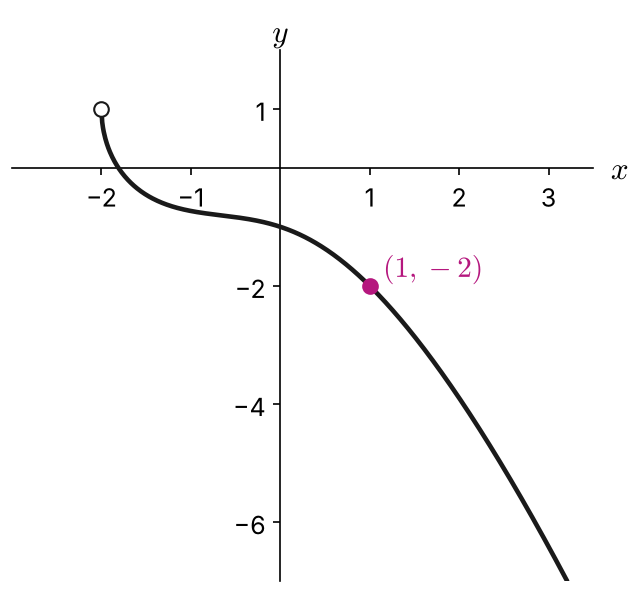
Graph of on . The curve starts at an open circle at with a vertical tangent, crosses the -axis at , passes through the initial point , and decreases ever more steeply to the right ( is about at ).
Theorem: Existence of a Unique Solution
Consider the first-order initial-value problem
Solve , subject to
Let be a rectangular region in the -plane defined by , that contains the point in its interior. If and are continuous on , then there exists some interval , , contained in , and a unique function , defined on , that is a solution of the initial-value problem.
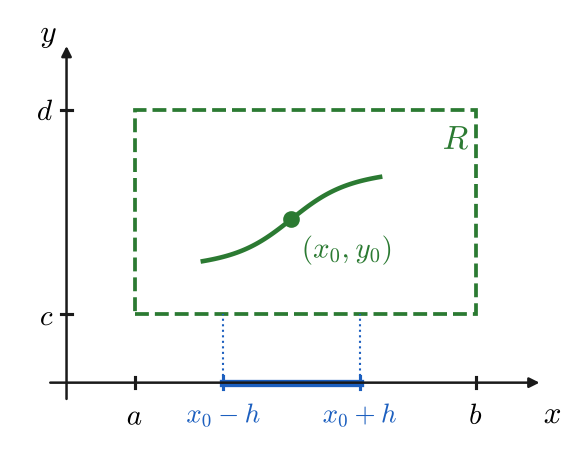
A rectangle with and contains the point in its interior. A solution curve passes through . On the -axis, the interval is marked inside .
We will consider higher-order DEs later in the course.
Example
Find an explicit solution of the given initial-value problem. Give the solution using a definite integral.
Solution
Separate the variables:
The integral on the right has no elementary antiderivative (just like ), so instead we create definite integrals, starting at the initial -value :
Tip: is a dummy variable: the letter is already used as the upper limit of integration.
Here . Solve for :
Answer: