8.4 Matrices for General Linear Transformations: Class Notes
Recall this example from section 1.8
Find the standard matrix A for the linear transformation for which and and use it to compute .
Tip: Write each standard basis vector in terms of and : if , then .
And #3 from 4.7
Consider the bases and for , where
a. Find the transition matrix to .
b. Compute the coordinate vector , where and use the transition matrix in part (a) to compute .
Tip
For (a), row reduce
For (b), row reduce .
Now we combine these two concepts.
#5
Let be defined by .
a. Find the matrix relative to the bases and , where
Solution
In , is the new basis and is the old basis. We find using an augmented matrix that has the new basis vectors as columns on the left and the images of the old basis vectors as columns on the right.
a. First find and .
The left side holds the new basis vectors ; the right side holds the images of the old basis vectors. Row reducing this gives us representations of and in terms of the vectors. That is, we’ll have and .
Answer:
This is the matrix for the transformation relative to the bases and . It acts on coordinate vectors relative to and returns coordinate vectors relative to .
b. Verify that the formula holds for every vector in .
b. Let .
Left side: find , the coordinate vector relative to for an arbitrary vector in . Solve :
Now multiply:
Right side: find , the coordinate vector relative to of the image of an arbitrary vector. Since , we use
So . The two sides are the same.
A specific example
Suppose we want to use to find , where .
Step 1: Express in terms of .
So . That is, .
Step 2: Multiply.
This is the same as .
Step 3: Use the new coordinate vector with .
Answer:
We can visualize the process as follows.
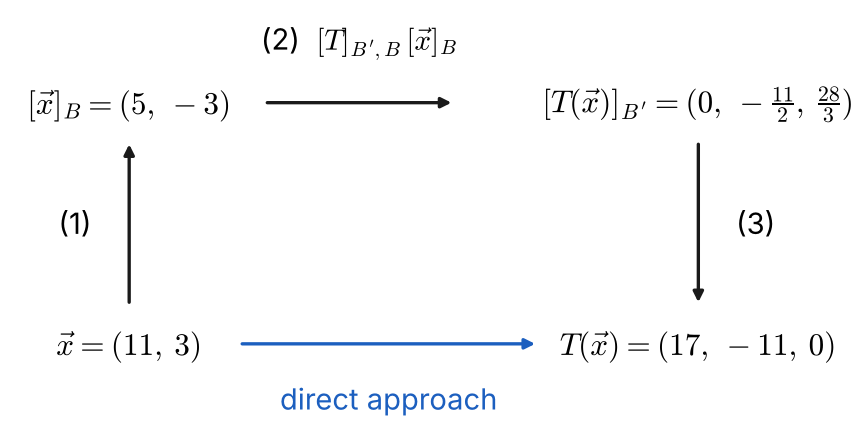
A diagram with four corners. Bottom left: . Arrow (1) goes up to top left: . Arrow (2), labeled , goes right to top right: . Arrow (3) goes down to bottom right: . A direct approach arrow goes straight from to using the formula .
Definition
Let be an -dimensional vector space with basis and let be an -dimensional vector space with basis . Suppose that is a linear transformation, and that for each vector in , the coordinate vectors for and are and , respectively. Then the matrix for relative to the bases and is written [by this author] as
This matrix has the property that .
#8
Let be the linear transformation defined by , that is,
a. Find relative to the bases and .
b. Use the three-step procedure illustrated in Example 2 to compute .
c. Check the result obtained in part (b) by computing directly.
Solution
a. Apply to each vector in :
Since is the standard basis for , the coordinate vectors are the coefficients (constant term first):
Answer:
b. Step 1: , so .
Step 2:
Step 3: .
Answer:
c. Directly:
This matches part (b).
Definition
In the special case where is a linear operator with , the matrix for is called the matrix for relative to the basis and is written [by this author] as
#18
Let be the differentiation operator .
a. Find the matrix for relative to the basis for in which .
b. Use the matrix in part (a) to compute .
Solution
a. Differentiate each basis vector:
That is,
These are relative to the standard basis for . To write them relative to , put the vectors on the left and the images on the right:
Answer:
b. To find , express in terms of .
So .
Answer:
Check: differentiating directly, .
Theorem 8.4.1
If and are linear transformations, and if and are bases for , , and , respectively, then
The matching highlights show that each basis appears on both sides: goes with , with , and with .
#13
Let be the linear transformation defined by and let be the linear transformation defined by . Let , , and .
a. Find , , and .
b. State a formula relating the matrices in part (a).
c. Verify that the matrices in part (a) satisfy the formula you stated in part (b).
Solution
a. Find from : apply to the vectors in .
For : , so
For : , so
b. The formula (Theorem 8.4.1):
Answer:
c. Multiply:
Theorem 8.4.2
If is a linear operator, and if is a basis for , then is one-to-one if and only if is invertible. Moreover, when these conditions hold, .