8.1 General Linear Transformations: Class Notes
Definition: (analogous to Theorem 1.8.2)
If is a mapping from a vector space to a vector space , then is called a linear transformation from to if the following two properties hold for all vectors and in and for all scalars :
a) (homogeneity property)
b) (additivity property)
In the special case where , the linear transformation is called a linear operator on the vector space .
Theorem 8.1.1 (analogous to Theorem 1.8.1)
If is a linear transformation, then:
a) .
b) for all and in .
c) for all in .
Proof of (a)
Since is linear, for all scalars . Let . Then
Examples of Linear Transformations
- defined by for all (the zero transformation)
- defined by (the identity operator)
- defined by (contraction if and dilation if )
- defined by (inner product of with ) [We’ll see this in Ch. 6]
- defined by
- defined by , where is a subspace of , and is a sequence of real numbers (evaluation transformation)
- defined by (differentiation)
- defined by (integration)
Theorem 8.1.2
Let be a linear transformation, for which the vector space is finite-dimensional. If is a basis for , then the image of any vector in can be expressed as
where are the coefficients required to express as a linear combination of the vectors in the basis .
That is, linear transformations preserve linear combinations.
Proof
Let . Then there are such that . So
The second line uses additivity and the third uses homogeneity. ✓
#20
Consider the basis for , where and , and let be the linear transformation such that and . Find a formula for and use that formula to find .
Solution
When we did this in 1.8, we wanted the standard matrix for the transformation. Here, we will find the formula.
We start by expressing as a linear combination of and :
This gives the system below; row reduce its augmented matrix:
Then, by Theorem 8.1.2, with and given,
Collect the first, second, and third components:
So
Answer:
Definition: (analogous to definitions seen in Section 4.2 (kernel) and Section 1.8 (range); also related to Definition 2 of Section 4.8 (null space) and, by Theorem 4.8.1, column space)
If is a linear transformation, then the set of vectors in that maps into is called the kernel of and is denoted by . The set of all vectors in that are images under of at least one vector in is called the range of and is denoted by .
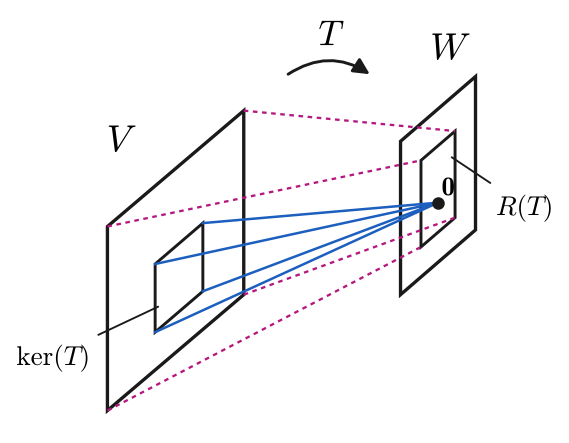
A linear transformation drawn as two planes, on the left and on the right. Inside is a smaller region, ; solid lines (in blue) show every vector in going to the single point in . Dotted lines (in magenta) from the corners of show all of going onto a smaller region of , the range , which contains .
#7
Determine whether the mapping is a linear transformation, and if so, find its kernel.
, where
a.
b.
Solution
Let and .
a) Checking checks both properties at once:
is linear.
Since , , and are linearly independent, this forces , so
b) , so is not linear (a linear transformation sends to by Theorem 8.1.1).
Answer:
a.
b.
#10
Let be the linear transformation defined by . Which of the following are in ?
a.
b.
c.
d.
Solution
The only polynomial with is the zero polynomial. It follows that , so only b is in .
Answer:
#11
Let be the linear transformation in Exercise 10. Which of the following are in ?
a.
b.
c.
d.
Solution
These are polynomials of degree less than or equal to 3 with constant term 0. Of the choices, only and have constant term 0.
Answer:
#25
Let be multiplication by . Find a basis for the kernel of , and then find a basis for the range of that consists of column vectors of .
Solution
So , , and . With ,
Letting , a basis for is .
The pivots are in columns 1, 2, and 3, so a basis for is
Answer:
:
:
Theorem 8.1.3
If is a linear transformation, then:
a) The kernel of is a subspace of .
b) The range of is a subspace of .
Definition: (analogous to Definition 1 of Section 4.9)
Let be a linear transformation. In the case that the range of is finite-dimensional its dimension is called the rank of T, denoted by ; and if the kernel of is finite-dimensional, then its dimension is called the nullity of T, denoted by .
Theorem 8.1.4 Dimension Theorem for Linear Transformations
(generalization of Theorem 4.9.2)
If is a linear transformation from a finite-dimensional vector space to a vector space , then the range of is finite-dimensional, and
.
#13
In each part, use the given information to find the nullity of the linear transformation .
a. has rank 3.
b. has rank 1.
c. The range of is .
d. has rank 3.
Solution
Nullity is . Recall that the vectors in are domain elements, so , where is the domain.
a. : , so .
b. : , so .
c. and the rank is 3, so .
d. : , so .
Answer: