6.2 Angle and Orthogonality in Inner Product Spaces: Class Notes
Definition
The angle between vectors and in a real inner product space is .
This is the same formula we saw with the dot product, where now comes from the inner product.
Example
Find the cosine of the angle between and with respect to the standard inner product on .
Solution
The standard inner product on multiplies entries in matching positions and adds the products:
Answer:
(So .)
Theorem 6.2.1 Cauchy-Schwarz Inequality (generalization of Theorem 3.2.4)
If and are vectors in a real inner product space , then .
This is a necessary result in order to compute the angle between vectors in an inner product space: it guarantees that the quotient inside the inverse cosine is between and 1.
Proof
If , then and , so both sides are 0 and the inequality holds.
If , then let , , , and let be any real number. By the positivity axiom,
Since , , so is a parabola that opens upward and is never below the axis. It either touches the axis once or does not cross it at all, so it has at most one real root. Then its discriminant is not positive:
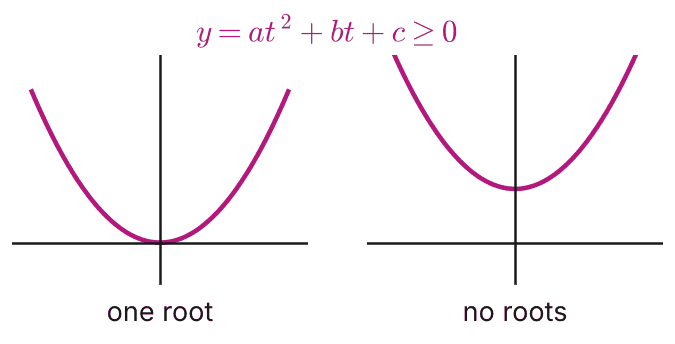
Two sketches of with . Left: the parabola opens upward and touches the horizontal axis at exactly one point (one real root). Right: the parabola opens upward and lies entirely above the axis (no real roots). In both cases .
Substituting for , , and :
Dividing by 4 and moving the second term to the right side gives the inequality in three equivalent forms:
The last form comes from taking square roots of both sides, and it is the statement of the theorem.
Theorem 6.2.2 Triangle inequalities (generalization of Theorem 3.2.5)
If , , and are vectors in a real inner product space , then:
a. (triangle inequality for vectors)
b. (triangle inequality for distances)
Proof of (a)
The first inequality holds because any real number is at most its absolute value, so . The second uses the Cauchy-Schwarz inequality, . Taking square roots (both sides are nonnegative) finishes the proof.
Proof of (b)
Subtract and add inside the norm, then use part (a) in the form :
Definition
Two vectors and in a real inner product space are orthogonal if .
#10
Show that the vectors are orthogonal with respect to the standard inner product on .
,
Solution
Multiply matching coefficients and add:
Answer:
#33
Let have the integral inner product and let and .
a. Find .
b. Find and .
Solution
a. Expand: , an odd function, so its integral over is 0.
Answer:
b. In , the term is odd, so its integral over is and it drops out.
Similarly, in the odd term integrates to :
Answer:
Explore
What is ? What about ?
Using and from #33: , so
So . This works because and are orthogonal (#33a).
Theorem 6.2.3 Generalized Theorem of Pythagoras
If and are orthogonal vectors in a real inner product space, then .
Proof
since means .
Example
Let , , and let have the standard inner product.
a. Compute the following: and .
b. Now let have the inner product . Find so that and are orthogonal.
c. Using this new inner product, compute .
Solution
a. The polynomial has no term and has no constant term.
Answer:
b. With the new inner product, set equal to 0 and solve for :
Answer:
c. Now , so the coefficients are multiplied by 2:
Answer:
Under the standard inner product and were orthogonal, but under the new one they are not. Orthogonality is based on the vectors and how the inner product is defined.
#17
Do there exist scalars and such that the vectors , , are mutually orthogonal with respect to the standard inner product on ?
Solution
Each pair must have inner product 0:
The second and third conditions force and . But then the first condition fails:
Answer:
Definition
(inner product space analog of Definition 2 in Section 4.9) If is a subspace of a real inner product space , then the set of all vectors in that are orthogonal to every vector in is called the orthogonal complement of and is denoted by the symbol (pronounced “ perp”).
Theorem 6.2.4 (generalization of Theorem 4.9.6 (a) and (b))
If is a subspace of a real inner product space , then:
a) is a subspace of .
b) .
Theorem 6.2.5 (generalization of Theorem 4.9.6(c))
If is a subspace of a real finite-dimensional inner product space , then the orthogonal complement of is , that is, .
#28
Find a basis for the orthogonal complement of the subspace of spanned by the vectors.
, , ,
Solution
Let be a vector in the orthogonal complement. Then , and so on for , , and . For example, the first condition is
Recall
The solution space of a homogeneous system is the orthogonal complement of the row space of the coefficient matrix.
So put the vectors in the rows of a matrix and row reduce:
Writing the unknowns as , the nonzero rows give
Let , , and (the free variables). Then
These three vectors form a basis for the orthogonal complement. Multiplying each one by gives another basis, with fewer minus signs:
Answer: