4.2 Subspaces: Class Notes
Definition
A subset of a vector space is called a subspace of if is itself a vector space under the addition and scalar multiplication defined on .
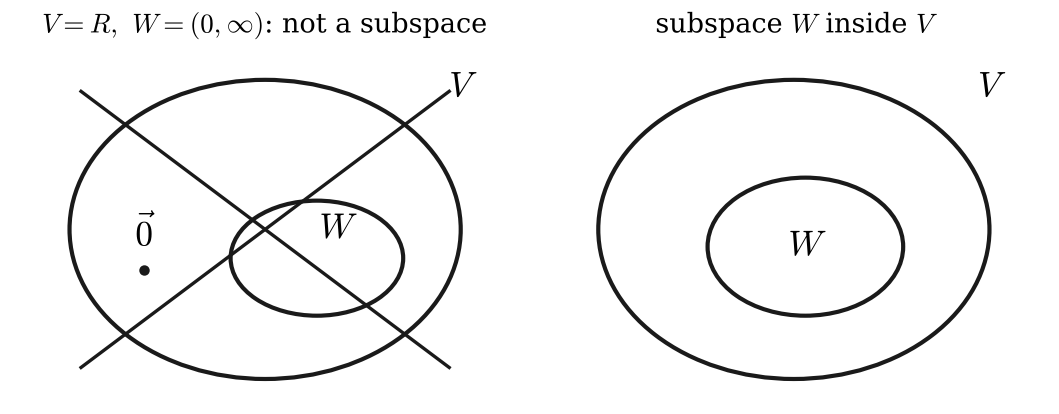
Left (crossed out): drawn as a large region containing , with the zero vector inside but outside . Because , this is not a subspace. Right: a subspace drawn as a smaller region inside .
Theorem 4.2.1 Subspace Test
If is a nonempty set of vectors in a vector space , then is a subspace of if and only if the following conditions are satisfied.
a) If and are vectors in , then is in .
b) If is a scalar and is a vector in , then is in .
Tip: Because must be nonempty, we sometimes see a step 0 before (a): show .
Since any vector is also in and the operations are the same throughout , axioms 2, 3, and 7–10 are satisfied. (These are inherited.) To show is itself a subspace, we need to confirm axioms 1, 4, 5, and 6.
If Axiom 6 is satisfied ( for all ), then it is true for (giving Axiom 4) and (giving Axiom 5).
Thus is a subspace if Axioms 1 and 6 are satisfied.
#3
Use the Subspace Test to determine which of the sets are subspaces of .
is the set of matrices with the standard operations of addition and scalar multiplication.
a. The set of all diagonal matrices.
b. The set of all matrices such that .
c. The set of all matrices such that .
d. The set of all symmetric matrices.
Solution
a. (Optional first step) The zero matrix
is a diagonal matrix, so the set is nonempty.
Let
a diagonal matrix, so .
which is diagonal, so .
Answer:
b. Not a subspace. Let
Then . But , so .
Answer:
c. Let and (so ):
so is in the set. Let :
so is in the set.
Answer:
d. For you.
#6
Use the Subspace Test to determine which of the sets are subspaces of .
is the set of polynomials of degree .
a. All polynomials of the form in which , , , and are rational numbers.
b. All polynomials of the form in which and are real numbers.
Solution
a. Not a subspace. If , then the set (for example, has an irrational coefficient).
Answer:
b. Let and , where , and let .
which has the form with .
where .
Answer:
#11
Use the Subspace Test to determine which of the sets are subspaces of .
a. All matrices of the form .
b. All matrices of the form .
c. All matrices such that .
Solution
b. Not a subspace:
is not of the form , because .
Answer:
c. Let and be in the set. Then and , and
Answer:
#14
Use the Subspace Test to determine which of the sets are subspaces of .
a. All vectors in such that , where
b. All vectors in such that , where is as in part (a).
Solution
a. Not a subspace. Consider :
Or: let with and . Then
Answer:
b. for every , so the set.
Let be in the set, so . Then
is in the set.
Let . Then , so is in the set.
Answer:
Theorem 4.2.3
The solution set of a homogeneous system of equations in unknowns is a subspace of .
This is proved by generalizing #14(b).
Definition
The solution set of a homogeneous system in unknowns is a subspace of , called the solution space of the system.
Definition
Let be multiplication by the coefficient matrix . The solution space of is the set of vectors in that maps into the zero vector in . This set is called the kernel of the transformation.
Theorem 4.2.4
If is an matrix, then the kernel of the matrix transformation is a subspace of .
Theorem 4.2.2
If are subspaces of a vector space , then the intersection of these subspaces is also a subspace of .
Proof
Let .
Work on this.
Examples of Subspaces
is a subspace of every vector space
Any vector space is a subspace of itself
Subspace of
Lines through the origin
Subspaces of
Lines through the origin
Planes through the origin
The solution space of a homogeneous system in unknowns is a subspace of
Subspaces of
Symmetric matrices
Triangular matrices
Diagonal matrices
Subspaces of (The following is actually a sequence of nested subspaces)
, the set of functions continuous on
, the set of functions with continuous first-order derivatives on
, the set of functions with continuous -order derivatives on
, the set of functions with derivatives of all orders on
, the set of polynomials
, polynomials of degree
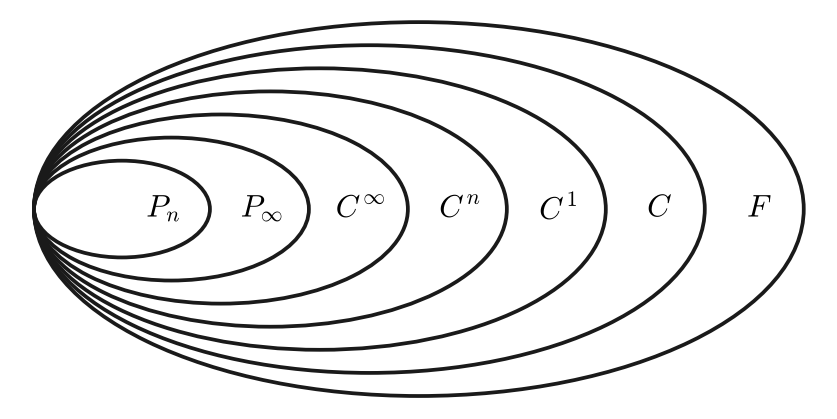
Nested regions, from outside in: , , , , , , . Each set is a subspace of every set that contains it.