3.3 Orthogonality: Class Notes
Definition
Two nonzero vectors and in are said to be orthogonal (or perpendicular) if . We will also agree that the zero vector in is orthogonal to every vector in .
We write for “ is perpendicular to .”
Definition
A vector that is orthogonal to a line in or or a plane in is called a normal.
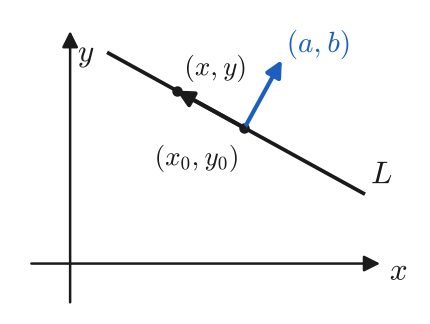
A line through with normal vector . For any other point on , the vector lies along the line, so it is perpendicular to the normal.
#4
Find a point-normal form of the equation of the plane passing through and having as a normal.
,
Solution
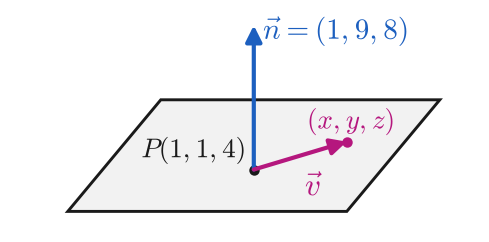
A plane through with normal drawn from . The vector goes from to any point in the plane.
is a vector in the plane for a point in the plane. Then
Answer:
Expanding gives the general form .
Theorem 3.3.1
a) If and are constants that are not both zero, then an equation of the form represents a line in with normal .
b) If , , and are constants that are not all zero, then an equation of the form represents a plane in with normal .
Theorem 3.4.3 (not a typo)
If is an matrix, then the solution set of the homogeneous linear system consists of all vectors in that are orthogonal to every row vector of .
Consider the homogeneous system
Each equation is a dot product of a row of with . For example, the first equation is
Shifting gears a bit,
Theorem 3.3.2 Projection Theorem
If and are vectors in , and if , then can be expressed in exactly one way in the form , where is a scalar multiple of and is orthogonal to .
Proof
parallel to means . Then
since ( is orthogonal to ). So
Definition
When , a vector in , is expressed as , where is a scalar multiple of a vector in ,
is called the orthogonal projection of on or the vector component of along . The vector
is called the vector component of orthogonal to .
#20
Find the vector component of along and the vector component of orthogonal to .
,
Solution
The component along is and the component orthogonal to is .
Answer:
Answer:
Check: , and
Standard matrix for a transformation: its columns are the images of the standard basis vectors,
#38
Find the standard matrix for the orthogonal projection of onto the stated line, and then use that matrix to find the orthogonal projection of the given point onto that line.
The orthogonal projection of onto the line that makes an angle of with the positive -axis.
Solution
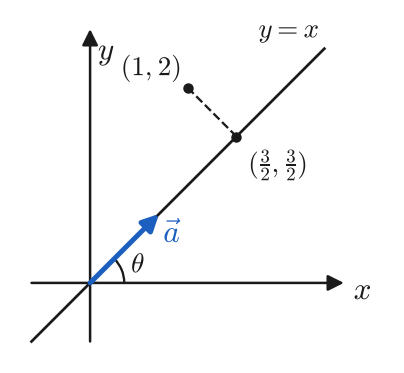
The line makes angle with the positive -axis. The unit vector points along the line. The point drops perpendicularly (dashed) to the point on the line.
Find the image of on and . A unit vector on the line is , so .
These are the first and second columns of the standard matrix:
Answer:
In general, the matrix for orthogonal projection onto the line at angle is denoted :
Recall
#36
Find the standard matrix for the reflection of about the stated line, and then use that matrix to find the reflection of the given point about that line.
The reflection of about the line that makes an angle of with the positive -axis.
Solution
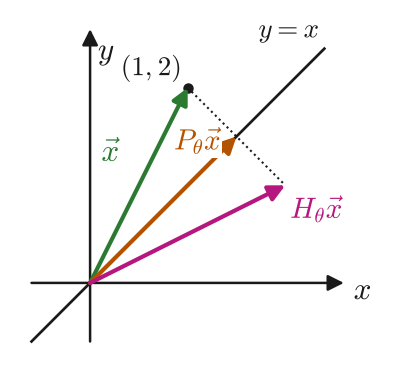
The given vector ends at . Its projection ends on the line , halfway between and the desired vector , the reflection, which ends at . The dotted segment from to is perpendicular to the line.
The distance between and is half the distance between and , and they point the same way. Thus
where is the identity matrix. So
(Using .) Here , so
Answer:
Theorem 3.3.3 Theorem of Pythagoras in Rn
If and are orthogonal vectors in with the Euclidean inner product, then .
The Euclidean inner product is the dot product.
Proof
since .