3.2 Norm, Dot Product, and Distance in Rⁿ: Class Notes
Definition
If is a vector in , then the norm of (also called its length or magnitude) is denoted by [by this author], and is defined by the formula .
Theorem 3.2.1 Properties of the norm of a vector
If is a vector in and is any scalar, then:
a)
b) if and only if
c)
Proof of (c)
Let .
(The last step uses .)
Definition
The norm of a unit vector is 1. We can obtain a unit vector from a nonzero vector by multiplying by the reciprocal of its length. This process is called normalizing the vector.
#1
Find the norm of and a unit vector that is oppositely directed to .
a.
b.
Solution
a. , so
Multiply by : the negative sign reverses the direction and dividing by the norm makes the length 1.
This has length 1 and is oppositely directed to .
Answer:
b.
Answer:
Definition
The standard unit vectors in are the standard basis vectors for , , , , .
Recall
In : , .
In : , , .
Every vector in can be expressed as a linear combination of the standard basis vectors:
Definition
If and are points in , then we denote the distance between and by and define it to be
#4
Evaluate the given expression with , , and .
a.
b.
c.
d.
Solution
a.
so
Answer:
b. Note: this is the distance between and , .
Answer:
c. By Theorem 3.2.1(c), , so
(Numerically, and .)
Answer:
d.
Answer:
Definition
Let and be nonzero vectors in positioned so that their initial points coincide. The angle between and is the angle determined by and such that .
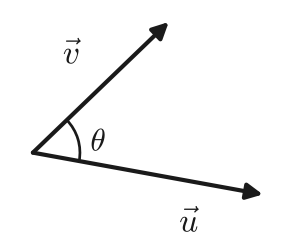
and start at the same point; is the angle between them.
Definition
If and are nonzero vectors in or , and if is the angle between and , then the dot product or Euclidean inner product of and is denoted by and is defined as . If or , then we define to be 0.
Tip: For numbers, , , , and all mean the same product. In the dot is required.
Definition
If and are vectors in , then the dot product or Euclidean inner product of and is denoted by and is defined by .
To connect the two definitions, let and share an initial point in , and let and be their terminal points, respectively.
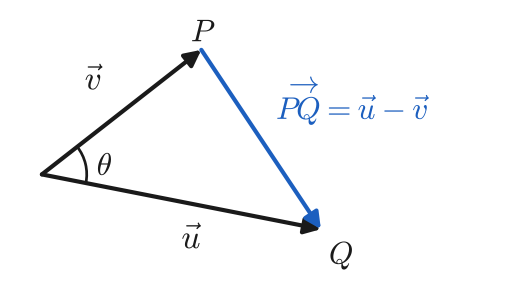
ends at and ends at , with angle between them. The third side, , has length . The other two sides have lengths and .
Recall: Law of Cosines
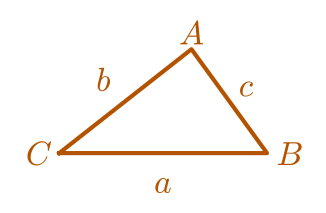
Side is opposite angle , side opposite , and side opposite .
By the Law of Cosines,
Write the left side and the squared norms in components:
Each square on the left expands, e.g. . The squared terms appear on both sides and cancel, leaving
So the two definitions agree in . In the same argument gives just .
#10
Find , , and .
a. ,
b. ,
Solution
a.
Answer:
b.
Notice .
Answer:
#11
Find the Euclidean distance between and and the cosine of the angle between those vectors. State whether that angle is acute, obtuse, or .
a. ,
b. ,
Solution
From the definition, , so .
a.
Since , : the angle is acute.
Answer:
Tip: On the unit circle, on the right half (angles between 0 and ) and on the left half (angles between and ).
b.
Answer:
Theorem 3.2.2 Properties of the dot product
If , , and are vectors in and if is a scalar, then:
a) (symmetry property)
b) (distributive property)
c) (homogeneity property)
d) and if and only if (positivity property)
Proof of (b)
Let , , and .
Theorem 3.2.3 More properties of the dot product
If , , and are vectors in and if is a scalar, then:
a)
b)
c)
d)
e)
Theorem 3.2.4 Cauchy-Schwarz Inequality
If and are vectors in , then or in terms of components
This is a necessary result for the cosine definition of the dot product in :
so always gives a value between and 1, and the angle makes sense in .
Theorem 3.2.5 Triangle Inequalities
If , , and are vectors in , then:
a) (triangle inequality for vectors)
b) (triangle inequality for distances)
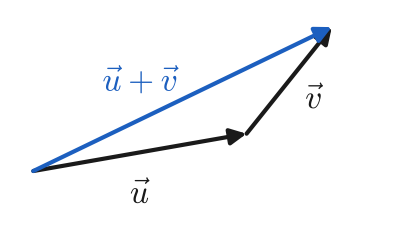
and placed tip to tail, with as the third side. A side of a triangle is never longer than the other two sides combined.
Proof of (a)
(by the definitions of norm and dot product and a property of absolute value: )
(by the Cauchy-Schwarz inequality). Taking square roots yields .
Proof of (b)
Part (b) follows from part (a) and the definition of distance.
Note: An expression like does not have meaning ( is a number, and a number can’t be dotted with a vector). But we can consider matrix multiplication using the dot product: if is an matrix and and are matrices, then
(Sizes: is and is ; and are ; is .)
Last note: If we represent () by its rows and () by its columns,
then each entry of is a dot product of a row of with a column of :