1.7 Diagonal, Triangular, and Symmetric Matrices: Class Notes
Definition
A square matrix in which all the entries off the main diagonal are zero is called a diagonal matrix.
Is diagonal? Yes: every entry off the main diagonal is zero (the diagonal entries are allowed to be zero too).
#3
Find the product by inspection.
Solution
Multiplying on the left by a diagonal matrix multiplies each row by the corresponding diagonal entry: row 1 by 3, row 2 by , row 3 by 2.
Answer:
#8
Find , , and (where is any integer) by inspection.
Solution
Powers of a diagonal matrix are found by raising each diagonal entry to that power.
Answer:
Answer:
Answer:
Definitions
A square matrix in which all entries below the main diagonal are zero is an upper triangular matrix. A square matrix in which all entries above the main diagonal are zero is a lower triangular matrix. If a matrix is either upper triangular or lower triangular (or both), it is said to be triangular.
A diagonal matrix is also triangular.
Consider , a square matrix.
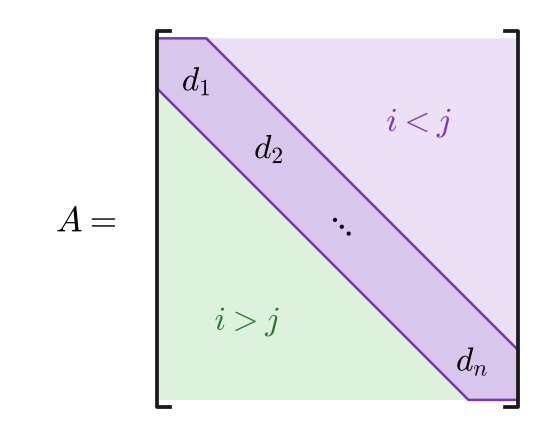
A square matrix with diagonal entries . The entries on and above the main diagonal (the region where , plus the diagonal) are shaded purple. The entries below the main diagonal (where ) are shaded green.
In an upper triangular matrix, any nonzero entries are on or above the main diagonal (entries with are zero). In a lower triangular matrix, any nonzero entries are on or below the main diagonal (entries with are zero).
Theorem 1.7.1 Properties of Triangular Matrices
- The transpose of a lower triangular matrix is upper triangular, and the transpose of an upper triangular matrix is lower triangular.
- The product of lower triangular matrices is lower triangular, and the product of upper triangular matrices is upper triangular.
- A triangular matrix is invertible if and only if its diagonal entries are all nonzero.
- The inverse of an invertible lower triangular matrix is lower triangular, and the inverse of an invertible upper triangular matrix is upper triangular.
Proof of (a)
(Lower triangular.) Let be a lower triangular matrix. Then if , that is, if the row number is less than the column number. But
and for , that is, if the row number is greater than the column number. is then upper triangular.
#19
Determine by inspection whether the matrix is invertible.
Solution
The matrix is upper triangular. Since , it is not invertible (Theorem 1.7.1 (c)).
Answer:
#23
Find the diagonal entries of by inspection.
Solution
Both matrices are upper triangular, so (see #46) each diagonal entry of is the product of the corresponding diagonal entries: , , .
Answer:
#46
Prove: If the matrices and are both upper triangular or both lower triangular, then the diagonal entries of both and are the products of the diagonal entries of and .
Proof of the upper triangular case
The th entry of comes from row of , , and column of , .
Let and be upper triangular matrices. Then and if .
If (or ), , and if (or ), . [Thus, is upper triangular.]
But if , then (one of the two factors is below the diagonal), so
Definition
A square matrix is said to be symmetric if .
Theorem 1.7.2 Algebraic Properties of Symmetric Matrices
If and are symmetric matrices with the same size, and if is any scalar, then:
- is symmetric.
- and are symmetric.
- is symmetric.
Theorem 1.7.3
The product of two symmetric matrices is symmetric if and only if the matrices commute.
Theorem 1.7.4
If is an invertible symmetric matrix, then is symmetric.
Theorem 1.7.5
If is an invertible matrix, then and are also invertible.
Proof
invertible is invertible (Theorem 1.4.9). Then and are each products of invertible matrices, and so are invertible by Theorem 1.4.6.